
JCS Analytics
JCS Analytics
  • Home
  • About
  • Privacy

Details
By J. Smith
J. Smith
Articles
January 20,2025
Last Updated: 20 January 2025
Hits: 1011
  • Gefion AI Supercomputer
  • Denmark AI Innovation
  • Sustainable AI Technology
  • AI Advancements
  • Quantum Computing Research

Denmark’s Gefion AI Supercomputer Revolutionizes AI-driven Research

Gefion AI Supercomputer

Abstract

Denmark's AI supercomputer, Gefion, marks a pivotal moment in artificial intelligence and research innovation. Built on NVIDIA’s DGX SuperPOD platform, Gefion is designed to tackle critical global challenges across various sectors, including healthcare, climate science, and quantum computing. The supercomputer combines unparalleled computational power with a commitment to sustainability, hosted in a data center powered by 100% renewable energy. As Denmark’s first sovereign AI infrastructure, Gefion preserves cultural and linguistic nuances in AI models, empowering local and global research communities. Its launch underscores the necessity for nations to adopt transformative technologies to remain competitive in the rapidly evolving AI landscape.

Key Points

  • Gefion Launch: Denmark introduces its first AI supercomputer, Gefion, built on NVIDIA’s DGX SuperPOD platform, marking a milestone in AI research.
  • Cutting-edge Capabilities: With 1,528 NVIDIA H100 GPUs and sustainable energy use, Gefion powers advanced research in healthcare, climate science, and quantum computing.
  • Sovereign AI Infrastructure: Preserves Denmark’s cultural and linguistic nuances, enabling localized and meaningful AI solutions.
  • Global Impact: Sets an example for nations to harness AI for addressing global challenges like climate change and food security.
  • Driving Innovation: Empowers academic, startup, and industrial collaborations to push AI boundaries.

Read more: Denmark’s Gefion AI Supercomputer Revolutionizes AI-driven Research

Details
By J. Smith
J. Smith
Articles
November 24,2024
Last Updated: 21 December 2025
Hits: 1179
  • Tableau Visualizations
  • SQLite Database Management
  • CGM Data Analysis
  • Python Data Processing
  • Diabetes Data Analytics

Working with CGM Data: Python, SQLite, and Tableau in a 4-Part Series

%%sql
-- Find the total count of duplicate rows in the CLARITY_DATA table
SELECT SUM(duplicate_count - 1) AS total_duplicates
FROM (
    SELECT COUNT(*) AS duplicate_count
    FROM CLARITY_DATA
    GROUP BY Date, Time, DateTime, Value, Treatment, Source
    HAVING COUNT(*) > 1
) as duplicates;

Abstract

A comprehensive 4-part series on analyzing continuous glucose monitor (CGM) data using Python, SQLite, and Tableau. Each part focuses on a specific step of the process, from building a clean dataset to creating interactive visualizations. Designed to be accessible for readers of all expertise levels, the series provides practical guidance for managing and interpreting CGM data. The post also links to each detailed article, providing a clear pathway for readers to follow the project step by step.

Key Points

Purpose of the Series: Guide readers through the process of analyzing CGM data, demonstrating practical applications of Python, SQLite, and Tableau.

  • Overview of the Steps:
    • Part 1: Build and prepare the base dataset with Python.
    • Part 2: Use SQLite to manage a growing dataset efficiently.
    • Part 3: Clean and process new data for consistency and reliability.
    • Part 4: Create insightful visualizations with Tableau.

Read more: Working with CGM Data: Python, SQLite, and Tableau in a 4-Part Series

Details
By J. Smith
J. Smith
Articles
November 24,2024
Last Updated: 24 April 2025
Hits: 544
  • Continuous Glucose Monitoring
  • CGM Data Visualization
  • Data Analysis with Tableau
  • Time in Range Metrics
  • Glycemic Variability

Working with CGM Data: Part 4 – Visualizing the Data in Tableau

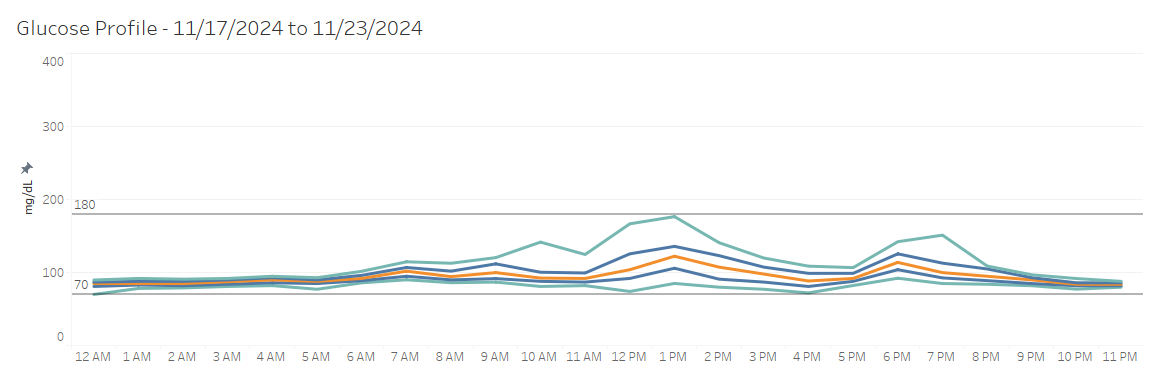
Profile

Abstract

This post concludes the "Working with CGM Data" series by demonstrating how to create insightful visualizations in Tableau using continuous glucose monitor (CGM) data. It covers two visualization categories—CGM-style and data analysis-style—and highlights their unique features and applications. Advanced Tableau techniques, including calculated fields and dynamic parameters, ensure precise and actionable insights. This guide demonstrates how to translate raw CGM data into actionable visual reports, creating a framework for analyzing glucose management trends.

Key Points

  • Focus on Visualizing CGM Data: Demonstrates advanced Tableau techniques to create CGM-style and data analysis-style visualizations.
  • Categories of Visualizations:
    • CGM-Style Reports: Overview, Daily View, Comparison, Overlay, and Profile reports mimic traditional CGM reporting formats.
    • Data Analysis-Style Reports: Range and Variation, Variation by Time of Day, and experimental Time in Tight Range metrics for deeper insights.
  • Advanced Tableau Features: Includes 55 calculated fields, 7 parameters, and precision techniques such as dynamic GMI calculations for increased usability.
  • Insights Gained: Explores metrics like Time in Range, Coefficient of Variation, and glucose patterns to provide comprehensive data-driven insights.
  • Interactive Online Dashboards: Visualizations are accessible on Tableau Public for exploration and reference.
  • Not for Medical Use: Visualizations focus on data analysis and are not intended for guiding treatment decisions.

Read more: Working with CGM Data: Part 4 – Visualizing the Data in Tableau

Details
By J. Smith
J. Smith
Articles
November 24,2024
Last Updated: 21 December 2025
Hits: 564
  • CGM Data Processing
  • SQLite Database Management
  • Continuous Glucose Monitoring
  • Data Cleaning Techniques
  • Tableau Visualization Prep

Working with CGM Data: Part 3 - Cleaning and Processing New Data with Python and SQLite

# Import packages

# For data manipulation
import numpy as np
import pandas as pd

# For working with datetime objects
from datetime import datetime

# For working with SQLite databases
import sqlite3

Abstract

Establishing a reliable and efficient process for managing continuous glucose monitor (CGM) data ensures the dataset remains accurate, consistent, and manageable. Using Python and SQLite, new data is cleaned, validated , and added to the database, and prepped for visualizations in Tableau.

Key Points

  • Data Storage: Only the most recent 90 days of CGM data are stored in the SQLite database, optimizing storage and focusing on relevant data.
  • Data Validation: Duplicate entries are removed, missing dates are identified, and the dataset remains complete.
  • Efficient Integration: New data is appended to the existing database without overwriting or redundancy.
  • Prepared for Visualization: Cleaned and validated data is ready for use in visualization tools like Tableau.

Read more: Working with CGM Data: Part 3 - Cleaning and Processing New Data with Python and SQLite

Details
By J. Smith
J. Smith
Articles
November 23,2024
Last Updated: 21 December 2025
Hits: 457
  • Python
  • SQLite
  • SQL Magic
  • CGM Data Handling
  • Data Validation

Working with CGM Data: Part 2 – Creating a Database with SQLite to Manage a Growing Dataset

# Import packages

# For data manipulation
import pandas as pd

# For working with SQLite databases
import sqlite3

Abstract

Explore the use of Python, SQLite, and SQL Magic to manage growing datasets efficiently.

Key Points

  • Problem Addressed: Managing a growing CGM dataset efficiently, moving beyond CSV files to a scalable database solution.
  • SQLite for Scalability: SQLite's serverless nature and Python integration make it an ideal choice for local data management and rapid deployment.
  • Using SQL Magic: SQL Magic in Jupyter Notebook allows for interactive SQL queries, combining Python’s flexibility with SQL’s powerful capabilities.

Read more: Working with CGM Data: Part 2 – Creating a Database with SQLite to Manage a Growing Dataset

More Articles …

  1. Working with CGM Data: Part 1 – Building the Base Dataset with Python
  2. 5K@EASD Race Results: Trends from 2023 and 2024
  3. Advanced Data Retrieval with Python
  4. Visualizing the 5K@ADA Race Results
  • 1
  • 2
  • 3
  • 4

Page 2 of 4

Recent Activity

April 2026

  • Novo Nordisk Expands Its AI Strategy Through New OpenAI Partnership

Articles

  • 5K@EASD Race Results: Trends from 2023 and 2024
  • Adapting the 5K@ADA Race Results Project for 2025
  • Advanced Data Retrieval with Python
  • Aligning CGM and BGM Readings Using Python and Tableau
  • Analysis and Visualization of Public Health Agency of Canada COVID Cases
  • Bridging Data and Healthcare in the Nordics
  • Complex Web Scraping with Python
  • Creating a Calculated Field in Tableau to Get Get Data Aggregated by Month in the Correct Order
  • Data Analyst vs. Business Analyst: Similarities and Differences
  • Data Analytics for Type 2 Diabetes
  • Data Science and Responsible AI in the Pharmaceutical Industry: A Case Study of Novo Nordisk
  • Denmark's Leap into AI Innovation: A Model for Future Research and Development
  • Denmark’s Gefion AI Supercomputer Revolutionizes AI-driven Research
  • Eli Lilly’s AI Strategy: Opening High-Value Drug Discovery Models to the Biotech Ecosystem
  • Embracing AI: Balancing Augmentation, Ethics, and Environmental Impact
  • Enhancing Data Analysis and Visualization Workflows with AI
  • Exploring the 2023 5K@EASD Virtual Run: A Tableau Analysis
  • Exploring the Growth of GLP-1 RA Sales
  • How an Hour-by-Hour View Transforms Time in Range Insights
  • How Novo Nordisk is Utilizing AI for Drug Discovery

Top Subjects

  • Tableau
  • Python
  • Novo Nordisk
  • Data Analytics
  • Data Visualization
  • Tableau Visualizations
  • AI
  • 5K@EASD
  • Data Analysis
  • 5K@ADA
  • Type 2 Diabetes
  • Data Cleaning
  • Drug Discovery
  • AI Innovation
  • Quantum Computing
  • Diabetes Management
  • Race Results
  • Diabetes Awareness
  • Virtual 5K
  • Continuous Glucose Monitor
  • SQLite
  • SQLite Database Management
  • Continuous Glucose Monitoring
  • CGM Data Analysis
  • Artificial Intelligence
  • AI in Healthcare
  • Healthcare Data
  • AI in Drug Discovery
  • NVIDIA
  • DATETRUNC

Contact Me

Search

End Diabetes Stigma

5K@ADA

5K@EASD

World Diabetes Day

Rochen Web Hosting

Bluesky Social

  • You are here:  
  • Home
  • Privacy
  • Articles
 
Copyright © 2026 JCS Analytics. All Rights Reserved.
Joomla! is Free Software released under the GNU General Public License.